





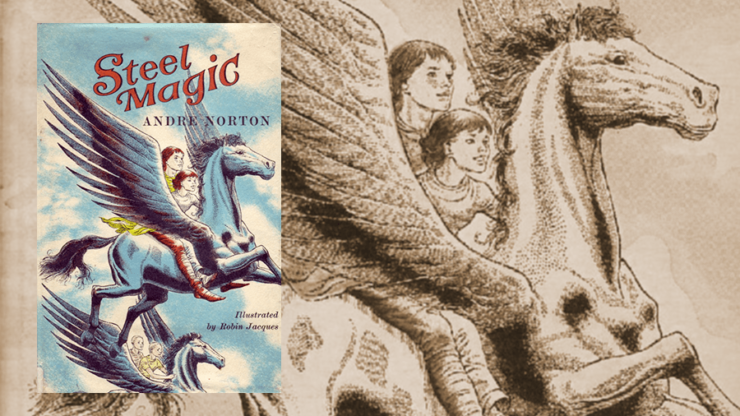
After reading and rereading so many Golden Age Norton space adventures, shifting to the Magic books feels like starting all over again with a new author. We’re in a completely different genre, children’s fantasy, and a completely different universe, revolving around kids and controlled by magic. Even the prose feels different: clearer, simpler, with fewer archaisms and stylistic contortions.
Steel Magic was the first of the series to be published, in 1965. It came in the midst of an efflorescence of kids’ fantasy, including A Wrinkle in Time (1962), and it built itself around cherished themes in the genre: magic, portals, groups of free-range siblings saving enchanted worlds.
Magic and portals were very much on Norton’s mind at the time—she was also writing and publishing the early Witch World books—but the genre would have been both dear and familiar to her. She mentions one other book in the novel, The Midnight Folk, which I hadn’t known at all. It turns out to be a 1927 novel by John Masefield—yes, that John Masefield, poet and Poet Laureate, whose “Sea Fever” was a staple of my school textbooks. He wrote prose for adults and children, as well. I had no idea.
For my personal literary canon, the closest analogue to Steel Magic would be C.S. Lewis’ Narnia books. Here as there, two brothers and a younger, innocent, traditionally girly sister (no Susan here; poor Susan, erased at the start) are dumped on an uncle while their parents are away on military business. The uncle lives in a mysterious mansion surrounded by equally mysterious grounds, and of course they go exploring and find a portal to a magical world.
Buy the Book
In An Absent Dream
The world they’re called into has close ties to our own, so much so that the evil of that world bleeds over into ours. Merlin the Enchanter tried to find another mortal to help fight the evil with the power of cold iron, but failed and had to return. It’s his mirror that serves as the portal.
Meanwhile he, King Arthur, and Huon of the Horn, all formerly mortal, have been robbed of their magical talismans: a sword, a horn, a ring. Greg, Eric, and Sara are brought through the portal by some incalculable power to recover the talismans and save both worlds.
Norton adds a few twists to the template. The kids’ magical talismans come to them by literal chance, when Sara wins a picnic basket at the Strawberry Festival in town. It’s a very modern basket, with plastic plates and cups, but the cutlery is steel, which is made of cold iron and is therefore poisonous to magical creatures. On their separate quests, each child chooses or is chosen by a utensil which magically transforms into a weapon.
To add to the challenges, the children have individual fears and phobias: the dark, water, and spiders. Each quest requires the child to face his or her fear and conquer it in order to win the talisman. Sara’s quest has an added complication, that a human can’t enter the place where Merlin’s ring is hidden. She has to do so in the form of a cat. (The ring she’s seeking, be it noted, has the power to transform a human into various animals.)
I’m not a fan of plot-coupon or grocery-list quest fantasy, and Steel Magic is solidly anchored in the genre. The quests are mechanically constructed; each kid has a similar adventure, runs into similar problems, and uses his or her weapon similarly, then loses it. The magical items get checked off the list, and the items’ owners are waiting passively to claim them, strongly (but not too strongly) obstructed by the bad guys.
The battle to save both worlds happens offstage. The kids have done their jobs, they get a round of thanks—but wait! They can’t go home! They left their magical items behind!
No problem, says Merlin. Zip, zap, there they are. Bye, kids, thanks again, don’t worry about us, have a nice mundane life.
And that’s that. As a tween I wouldn’t have had a lot of problems with this kind of plotting. It’s comforting to know that whatever terrors you may fall into on the other side of Merlin’s mirror, you can always go back to where you were before.
As an adult who remembers the picnic set and the presence of Merlin but nothing else, I wish there were more to this than ticking boxes and balancing separate characters in separate chapters. They don’t even get to be part of the great battle it’s all supposed to lead up to. They get patted on the head and sent off to bed, and then the adults take over.
It’s a little too kid-safe. Scary, but not too scary. Dangerous, but not too dangerous. Nothing really bad happens. At least the cutlery isn’t plastic, too.
The point of kids’ fantasy is that the adults have made a giant mess and the kids will save everything, and they won’t do it easily and they won’t always be safe, either. The Pevensies do it in the Narnia books, and Dorothy does it in Oz—there are Oz echoes here, what with the picnic basket and the wicked witch. Things get put back where they were, yes, but the kids don’t get sent home before the big battle. They star in it. For them, the stakes are real. They have far more to lose than their chance to go home.
I looked a bit askance at the extra obstacles in Sara’s quest, too. Unlike the boys, who are dumped out on their own, Sara isn’t allowed to find her own way, but has to be told what to do by a magical fox. She can’t even do it in her own form. She has to be changed into a cat—and is still forced to drag along her assigned weapon from the picnic basket.
Backwards and in heels, nothing. Try being a ten-pound cat hauling a steel picnic knife across rough country to a monster-infested castle. And then make her have to choose between her one weapon and the magical object she came to find—no hands, no clothes or carrier bag, just her mouth. Being a girl, Norton seems to say, is no picnic.
By this time Norton had started to write female characters with actual agency, but for the most part they were aliens: the reptilian Wyverns, the witches of Estcarp, Maelen the Thassa. Normal human girls in normal human form didn’t (yet) get to play.
At least Sara gets to have an adventure, and succeed at it, too. She even loses her fear of spiders.
I’ll be reading Octagon Magic next: more magic, more kids. Hopefully fewer obstacles for the girl protagonist.
Judith Tarr’s first novel, The Isle of Glass, appeared in 1985. Her most recent novel, Dragons in the Earth, a contemporary fantasy set in Arizona, was published by Book View Cafe. In between, she’s written historicals and historical fantasies and epic fantasies and space operas, some of which have been published as ebooks from Book View Café. She has won the Crawford Award, and been a finalist for the World Fantasy Award and the Locus Award. She lives in Arizona with an assortment of cats, a blue-eyed dog, and a herd of Lipizzan horses.


they won’t do it easily and they won’t always be safe, either.
“Must more people die for Edmund?” asks Aslan.
@1 And that’s why the Lewis is a great classic and this is not.
“grocery-list quest fantasy” is a great description.
I still have this book on my shelf. Very juvenile but there were elements I liked, and it was the first time I heard of Huon of the Horn. I thought the witch was cool and scary, and I loved the idea of being turned into a cat. I thought Sara’s story was the most interesting.
I *think* I read these as a kid. I certainly have a vague recollection of reading a series of X magic books by Andre Norton, so I think it must have been these. I recall very little of them except that I absolutely loved them at the time. Mind you, it was a long, long time ago…
Are you doing all 7 “Magic” stories? Steel (aka Gray), Octagon, Fur, Dragon, Lavender-Green, Red Hart, and the co-authored sequel to Dragon Magic: Dragon Mage? It’s really interesting to see how her storytelling for younger readers evolves between each of these stories. I think I enjoyed Lavender-Green Magic and Red Hart Magic the most and found the first 3 the most difficult to get through.
I’d also recommend reading (or watching the 1980’s tv version) of John Masefield’s The Box of Delights.
https://en.wikipedia.org/wiki/The_Box_of_Delights
Oh yes, Box of Delights with Patrick Troughton, aka The Second Doctor, wonderful!
As I recall I read Steel Magic as being primarily Sara’s book. It’s her picnic basket, she gets called ‘Lady Sara’ and the boys are just called her brothers. She gets the most complex and interesting quest. Maybe it was just I identified with her but for me it was all about the girl.
At age 8 I was hospitalized for a severe case of pneumonia, and this was the book that my Mom brought me from the library to read while I was there. For years, I’ve recalled the cover but not the name of the book. Thank you for the memory!
At age 8 in the mid-1970s, the plot coupon quest was still a new thing to me, and the fact that there was a female character who had any kind of adventure was amazing!
@6 I’m not sure I’ll do the collaboration, but I’ll reread the rest. Lavender-Green Magic was a favorite in its time.
It is amazing how many of us read these and were influenced by them.
I know I read at least some number of these back in the day, but couldn’t say which ones.
(I really, really regret not making a concerted effort to list every book I ever read starting back at age 5 or so.)
I remember reading Lavender-Green Magic in elementary school. It was the first portal quest story I’d read that featured black African-American characters. I immediately read Wraiths of Time after that and thought Andre Norton was a black author!
Does your edition have the cover art and illustrations by Robin Jacques? You forgot to mention them. He was one of the first artists I imprinted on; finding his work on/in Andre Norton books was added joy.
@13 – me too, re Robin Jacques. Those illustrations were beautiful.
I liked Sara as well She seemed to have plenty of agency in this book, which I craved reading about as a young girl. Characterisation beyond that and collecting plot tokens didn’t register with adolescent me (and I still love the biggest plot-tokeny book of all, The Dark Is Rising. Eddings and Brooks can bite it, however).